Commentary: Why China can’t quit ‘open’ AI
Alibaba’s shift towards closed-source AI models shouldn’t be representative of the broader landscape in China just yet, says Catherine Thorbecke for Bloomberg Opinion.
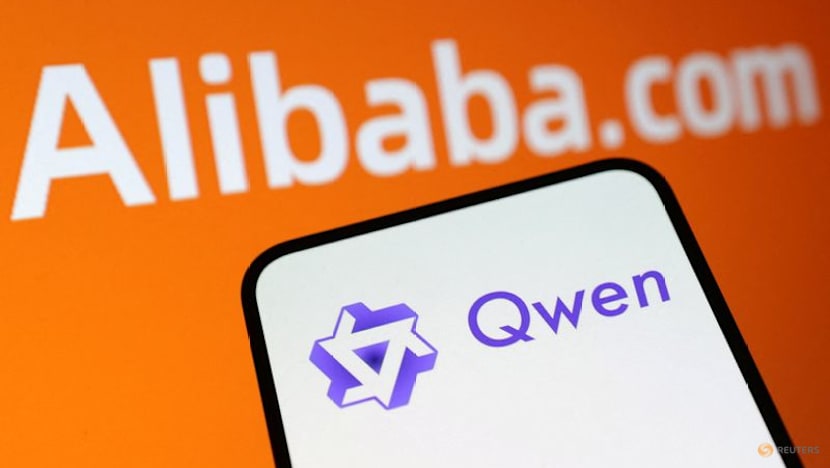
Qwen and Alibaba logos are seen in this illustration taken, January 29, 2025. REUTERS/Dado Ruvic/Illustration
TOKYO: China’s AI ecosystem has one defining difference from Silicon Valley: its embrace of open source. While America’s biggest companies race to build ever more powerful systems and insist only they can control them, Chinese labs have been giving the technology away for free.
Open source - making a model available for anyone to use, download and build on - once seemed a niche, nerdy topic that no one besides developers cared about. But when a new technology is driving trillions of dollars of investments and leading to immense concentrations of power, it offered an antidote.
That’s part of the reason I’ve spent the past year cheering for it, and urging the US to come up with its own strategy.
But it may have been too good to last. DeepSeek’s breakthrough R1 model spurred a frenetic year in AI, but now the bill is coming due. Earlier this month, Alibaba released its third proprietary AI model, breaking with the open approach that propelled China’s ecosystem, stoking fears that the retreat has begun.





BUILDING PRESSURE
The pressure was always coming.
Open-sourcing a model brings prestige and helps smaller labs win global attention. But it does not pay for the enormous cost of training and running AI.
Yet giving models away also served a strategic purpose: It weakened the moat the US is trying to build with its vast spending on the infrastructure needed to train and run models.
Alibaba’s shift, however, shouldn’t be representative of the broader landscape just yet. Part of the reason it’s causing concern among developers is because its Qwen family of models are the most popular globally, capturing more than half of the worldwide open-source model downloads. Qwen is also the most widely used base layer among researchers to build smaller, fine-tuned derivatives. These models power everything from Singapore’s government AI efforts to academic research labs in the developing world.
The strategy has made low-cost Chinese AI not just the go-to in price-sensitive markets across the Global South, but increasingly, as I’ve written before, in Silicon Valley. Last month, coding startup Cursor - valued at US$29.3 billion in November - revealed that its Composer 2 model was partially built off Beijing-based Moonshot’s Kimi K2.5, confirming long-running speculation.
A partner at venture capital firm Andreessen Horowitz has estimated that about 80 per cent of the companies pitching them that use open-source AI are employing Chinese models.


It may seem like China can’t afford to do this anymore, but giving it up could be more costly.
The strategy has been central to the nation’s AI rise. Labs publish weights (the numerical parameters that capture what a model has learned), letting others iterate, learn and distill them into new products. That has helped drive the frantic pace of innovation and spread it across the economy. Beijing has noticed, and open source now has the government’s blessing, becoming central to its tech ambitions.
Even before AI, open source was integral in China’s tech culture that famously refuses to pay for software. Code repository GitHub remains one of the few major Western sites still accessible behind the Great Firewall. As a former GitHub worker argues, this openness is the talent pipeline, and one reason China produces roughly half of the world’s AI researchers.
Open models still tend to trail proprietary ones by about six months. But this gap has stayed surprisingly narrow. And it raises an uncomfortable question for companies like OpenAI: How do you justify a US$852 billion valuation when Chinese rivals are giving away technology that is nearly as good?
It’s causing consternation in Washington. An advisory for US lawmakers last month warned that China “has opted to go all in on an open-source approach to AI”, threatening America’s lead. The report described a powerful flywheel as global uptake of Chinese AI creates a feedback loop that drives iteration and further adoption.
That makes a full-scale abandonment unlikely. Chinese labs may move toward a hybrid model, mixing open and proprietary releases, but they are unlikely to walk away from the strategy altogether.


REAL CONCERNS
There are legitimate concerns, especially after the hype and cybersecurity anxieties surrounding Anthropic’s new Mythos model, that open source could prove too dangerous. These fears shouldn’t be ignored; but some are reflexive.
Bad actors hoping to weaponise enormous models would still need immense computing resources. And openness brings its own safeguards the same way sunlight is the best disinfectant. More eyes can inspect flaws and vulnerabilities. The alternative is the familiar Big Tech line of “trust us, we know best”. At this stage, that is not especially reassuring.
Still, China’s brutal domestic competition is forcing companies to find ways to make money. Start-ups Zhipu and MiniMax have gone public, increasing pressure to satisfy shareholders. Alibaba, after reshuffling its AI research team, is also searching for ways to offset costs. Closing off its most advanced models and charging for them is one way to escape the race-to-the-bottom pricing that has defined the sector.
And it’s important to note that China’s AI industry has never been monolithic. ByteDance, for example, has always kept its models closed.
As much as Alibaba’s retreat looks like a turning point for the entire ecosystem, the shift is unlikely to happen all at once. China’s open source systems are still likely to dominate for years, even as the business models evolve. The next real test is DeepSeek. Its highly anticipated next release will reveal whether the national champion intends to preserve the tradition it helped supercharge or accelerate its decline.