Singapore responds to US probe, says it does not condone forced labour in supply chains
Responding to two US trade investigations, Singapore also says the United States has had a consistent trade surplus with Singapore for more than 20 years.
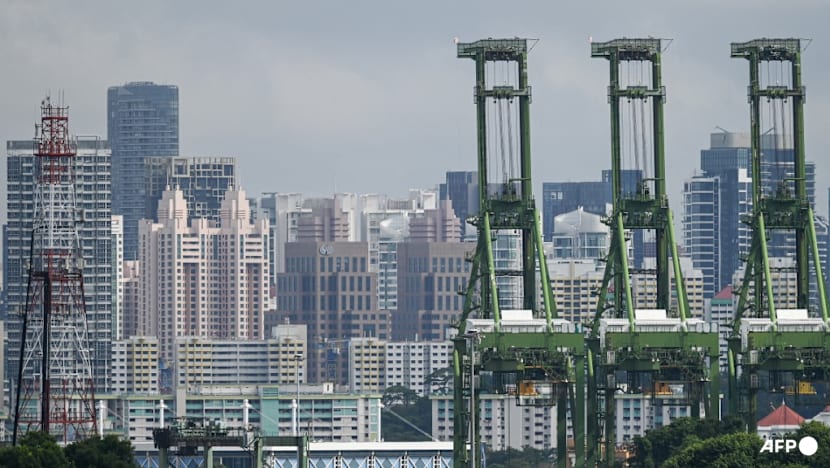
Cranes at Pulau Brani port terminal stand against the skyline in Singapore on Feb 25, 2025. (Photo: AFP/Roslan Rahman)

This audio is generated by an AI tool.
SINGAPORE: Singapore has told the United States that it does not condone the use of forced labour in supply chains and has a comprehensive framework to enforce against such illegal practices within its borders, as it responded to two US trade investigations.
In written submissions on Wednesday (Apr 15), the Ministry of Trade and Industry (MTI) addressed separate probes by the Office of the United States Trade Representative (USTR) – one into alleged structural excess capacity in manufacturing sectors, and the other on the effectiveness of Singapore’s measures to prevent the import of goods produced with forced labour.
MTI highlighted the strength and balance of Singapore’s economic relationship with Washington.
“The US has enjoyed a consistent trade surplus with Singapore for over 20 years,” MTI said, describing bilateral trade as mutually beneficial and market-driven.
LAWS AGAINST FORCED LABOUR





Singapore is among 60 economies, including Australia, Japan, South Korea, Indonesia and the United Kingdom, named in the USTR probe into whether they have taken sufficient steps to prevent the import of goods produced with forced labour.
In its written submission, MTI said Singapore takes a “firm stance” against forced labour and has a comprehensive legal and enforcement framework to tackle such practices domestically.
Forced labour is criminalised under the Penal Code, while the Prevention of Human Trafficking Act defines it as a form of exploitation and provides for penalties against offenders.
Relevant government agencies such as the Ministry of Manpower (MOM), the Ministry of Home Affairs and the Singapore Police Force investigate complaints that allege any breaches of domestic laws, MTI said.
Workers can also report suspected abuses through an MOM hotline, non-governmental organisations or to the police.
Singapore also emphasised its tripartite model, involving the government, employers and unions, as a key pillar of labour protection. This framework ensures that workers are informed of their rights, employers are held accountable, and labour standards are upheld, said MTI.
NO EVIDENCE OF LINKS TO FORCED LABOUR SUPPLY CHAINS
Singapore said it is not aware of any goods produced with forced labour that have been exported from Singapore to the US.
It noted that it has never been named in the US Department of Labor’s List of Goods Produced by Child Labor or Forced Labor since the report was first published in 2009.
There have also been no instances of US Customs and Border Protection issuing Withhold Release Orders on shipments from Singapore.
“Moreover, Singapore has cooperated with the US when there have been specific and credible allegations related to forced labour in supply chains that potentially violate US laws, and where such cooperative action is in accordance with Singapore’s domestic laws and relevant international obligations,” MTI said.
CHALLENGES IN POLICING GLOBAL SUPPLY CHAINS
Singapore said addressing forced labour is a complex, transnational issue that cannot be resolved through import bans on individual countries.
Such measures could lead to goods being rerouted to other markets rather than eliminating forced labour practices, MTI said.
“Beyond robust domestic regulation and enforcement against forced labour within our borders, our work thus far has indicated that there are limitations that many countries, including Singapore, face,” the ministry said.
These include the absence of a global regulatory framework or an internationally agreed list of goods produced with forced labour.
Investigating supply chains also requires access to overseas production facilities, worker testimonies and documentation, which depend on cooperation from authorities in source countries.
“Without such evidence, Singapore will not be able to viably and sustainably monitor whether shipments flowing in and out of Singapore or transshipped via Singapore are produced by forced labour,” MTI said.
“Singapore is open to exploring whether it may be possible to implement systems to identify or solicit such information.”
US TRADE SURPLUS
On the probe into structural excess capacity, MTI said the US has had a consistent trade surplus with Singapore for more than 20 years.
MTI pointed to US data, which showed that the goods trade surplus with Singapore rose from US$1.9 billion in 2024 to US$3.6 billion in 2025, while the services surplus increased from US$25.1 billion to US$29.6 billion over the same period.
The US also recorded surpluses in key sectors, including semiconductors and electrical equipment, as well as petrochemicals. While the US ran a deficit in pharmaceuticals, that gap narrowed significantly in 2025.
MTI noted that Singapore has been named in only one US anti-dumping investigation over the course of bilateral trade relations, which it said reflects alignment with international trade norms.
“These are the hallmarks of a longstanding and mutually beneficial economic relationship,” MTI said.
The ministry added that the US-Singapore Free Trade Agreement (USSFTA), in force since 2004, underpins this relationship.
Singapore imposes zero tariffs on US exports, while bilateral trade and its investments in the US support around 350,000 American jobs, MTI said.
Singapore is also the third-largest Asian investor in the US, with investment stock reaching US$71.7 billion in 2025, the ministry added.

INDUSTRIAL OCCUPANCY RATES HIGH: MTI
Addressing allegations of excess industrial capacity, Singapore said its industrial occupancy rates have remained consistently high.
“Occupancy rates for manufacturing-specific industrial spaces in Singapore have remained consistently high, at around 90 per cent, over the past five years, with reasonable buffers for frictional vacancy and cyclical factors,” MTI said.
This is in line with global norms for advanced economies and does not indicate oversupply, it added.
Market indicators such as steady growth in industrial property prices and rents, as well as strong demand in land tenders, further suggest there is no excess capacity, MTI said.
Singapore noted that land scarcity means it is not in the government’s interest to allow underutilisation, and that industrial spaces are actively redeveloped to meet demand.
EXPORTS DRIVEN BY MARKET FORCES
As a small country with no natural resources, Singapore’s economy is trade-dependent, said MTI.
It added that where Singapore has a trade surplus with other nations, it is a result of the market-driven outcomes of the country’s geography and open economy, rather than non-market-oriented government interventions.
“Singapore’s economic policies are carefully designed to ensure that market forces are not distorted,” MTI said, adding that the country adheres to international obligations under free trade agreements and the World Trade Organization.
Singapore typically imports lower-value inputs and exports higher-value products, contributing to positive net exports in sectors like electronics and energy & chemicals, MTI noted.
Conversely, Singapore runs deficits in sectors where it lacks natural advantages, such as agriculture and raw materials like steel and aluminium.